An official website of the United States government




Jeevan Narney: Poetry, resilience, and the Peace Corps

Ode to Sunflowers Struggling to Find the Sun in the Yellow Wind
With an anxious air in my throat I saw you during the springtime when the Yellow Wind would bud the air with Gobi dust. It’s not like a fan, more like a vacuum turned on without the bag, and all of you in it, your heads turning lopsided. So continue to grow up against the brick wall. Do not stop searching for the sun who is struggling to compete with that dim silt that shines and whines on your cloud-hosed soil. How envied you are even by our local star who would love to reflect your fire-mirage. Your face of seeds lands everywhere. They will surprise the weeds. They will volunteer your light.
April is National Poetry Month, and what more fitting way for the Peace Corps to mark the occasion than by interviewing a poet who is a Returned Peace Corps Volunteer (RPCV)? Jeevan Narney, a poet whose work has appeared in The Georgia Review, Nimrod Journal, and Verse Daily, is also an RPCV.
In talking with him, it becomes clear that his outlook on poetry and the Peace Corps is intertwined. In a way, Narney came to both poetry and the Peace Corps to “participate in the present.” As he puts it, “My grandfather was my main inspiration for joining in the end. He died shortly before I even got accepted [but] he worked and served in India all his adult life. He firmly believed in [the need to] give of yourself to others. I think a light bulb went on in my head after he died, that building peace and friendships is not just a two-year commitment, but a lifelong commitment, wherever you are in the world.”
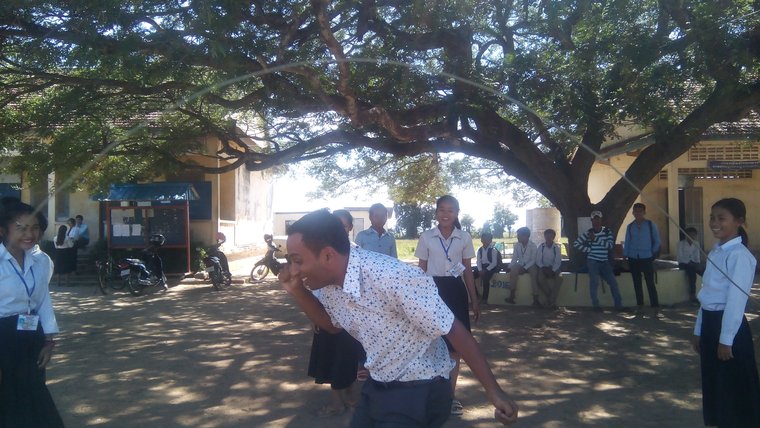
Although Narney didn’t know at first if he had the requisite resilience to be a successful Peace Corps Volunteer, he ultimately served in Cambodia as an Education Volunteer, teaching English as a second language from 2016 to 2018. The resilience came to him, it turned out, and that’s no surprise to readers of his poetry, who find resilience in words he wrote even before he joined the Peace Corps.
The following lines from his poem, “Ode to Sunflowers Struggling to Find Sun in the Yellow Wind,” were written about an experience in China and speak directly to resilience: So continue to grow up against the brick wall. Do not stop searching for the sun who is struggling to compete with that dim silt that shines and whines on your cloud-hosed soil.
When he talks about the poem, Narney points out that part of his inspiration was “... my own sense of surprise at … how things never seem what they look like or will become, and how life can feel that way.” This is, of course, a sentiment many Peace Corps Volunteers can identify with—the notion of how service is rife with surprise and things turn out differently than you may have thought they would. The project that took on a life of its own, the relationships you may never have seen coming yet are now flourishing, the community that seemed so different at first and now just feels like home.
Narney is committed to the idea of his work being alive, somehow, responsive, and agile. “Poetry characterizes not just our emotions,” he says, “but the sounds of those emotions in words. It’s rooted in the inner power to ask questions and search for answers beyond us. It has been a way to remember the past, to participate in the present, and invite people for a hopeful future. It doesn’t shy away from being bold in its assertions.”
Narney goes on to encourage any other poets out there who might be considering Peace Corps service to apply. “Living in a country other than your own teaches poets that global poetry is important. That the poets from other countries can help crack open different perspectives for writers.” Narney points out that a poet’s work “can easily become stagnant, if they don’t venture the world a bit.” He suggests the Peace Corps as an antidote.
“Peace Corps offers poets a chance to confront themselves … and can help them confront their writing through a different lens.” His implication, of course, is that immersing oneself in a new culture, a new language, and a new environment can level up the muse, so to speak. Getting out of one’s comfort zone to see new things, hear new sounds, and see new perspectives and landscapes has long been a tool for the artist. Narney elaborates by pointing out that “people from a different culture, who speak a different language, drink a different soup, and work their hands into the earth in a different way can plant new prompts of how to write, how to live, and how to be, and how to do.” His words will likely resonate with all who have served as Peace Corps Volunteers, whether they are poets or not. Most Volunteers experience the way immersion into the new contributes to personal growth, career growth, and new outlooks.
Narney says his poetry is evolving, which is, perhaps, the job of every poet—to keep challenging the work, to keep challenging readers, to keep challenging oneself.
“My writing has evolved over time throughout my travels around the world,” he says, and continues, “I believe a poet’s audience expands more by the friends you make, and the people whom you may not like so much, knowing they challenge your own resistance to reconciliation. My work went from relying often on traditional forms to breaking […] into more free verse poems. I play around with syntax as a way to find order in the disorder of life.”
He looks to other poets and to nature for inspiration. He explains, “I am exploring more about the natural world. The world is still a beautiful place, and I feel a strong duty to let my curiosity swim a little more towards celebrating worlds gained and grieving those that are lost or that we are losing. I have been exploring what it means to be a person of peace, and the deep struggle to be a person of peace when things might seem hopeless and forgone.”
In talking about his work and the way it evolves, Narney is deeply aware of the give-and-take in the poetry world—the way poems often work in conversation with other poems, creating a sort of poetic tapestry and call-and-response through times and cultures and across borders. He explains, “I can’t write without my fellow poets challenging me to look past my own clichés in writing, and a cliché is often a security blanket that we have to put away to face the sharp light or heavy darkness of this world. We have to be secure in enough in who we are at some point, and the best way I found to do that is by the communities I have invested in.”
So, as April marches on, and Peace Corps poets put pen to paper and distill their experiences into verse, what advice does Narney have for them?
“Always be real about your experiences—but in a way that shows your compassion and your own potential short sightedness. Remember, storytelling is a shared experience—avoid making it seem like a documentary. Your Peace Corps experience became your host communities’ experience, too. If you write about your host community, do it to show things that will help people appreciate that culture and will help disclose that community as people who are not outside of the world, but are, in fact, very much within the world. And of course, write about that special dance, special food, special conversation with teachers or host family, and that quiet moment you had to yourself, looking out into their landscape glittering with flowers.”
Poets? April is here, and it’s calling. Get writing.