An official website of the United States government


Fiji 72: A legacy of family and friends
Peace Corps sets a lifelong story into motion
In 1992, Peace Corps Fiji, Group 72, arrived for staging in San Francisco wide-eyed, idealistic, and largely unaware of how the next two years would shape their lives. They carried backpacks, expectations, and a sense that they were ready, or at least willing, to find out what Peace Corps was all about. Roommates and airplane seats were assigned alphabetically. Patti Reeder was paired with Divya Sharma, and Divya was seated next to Michael Thomas on the flight. It was an arbitrary system, yet it set a lifelong story in motion.
Fiji 72 began as a group of strangers tossed together and bound by a shared hope of being sworn in as Peace Corps Volunteers. The “fourth goal,” and what would eventually become a legacy, came later.
Patti served as a computer Volunteer with the Fiji Visitors Bureau in Suva, the capital. She describes her service as non-traditional and impactful. With hot water and air conditioning, she was often the butt of jokes from rural Volunteers who had neither, but the idea of service was the same: empower Fijians to take on new roles to support their country’s needs. Patti trained Fijian staff and computerized office systems in practical and durable ways. Her work resulted in a new position being created for a Fijian university graduate. The lesson was straightforward: define Peace Corps success on your own terms, and center local community.
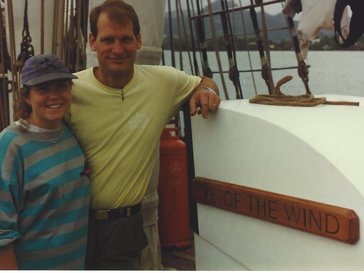
The Peace Corps officially has three goals. To help countries interested in meeting their need for trained people; to help promote a better understanding of Americans on the part of the people served; and to help promote a better understanding of other people on the part of Americans. Among Returned Volunteers, however, there is an unofficial fourth goal—the partner many Volunteers meet during service. It is not written anywhere, but the notion is widely understood. Patti’s fourth goal was Loel, whom she met in Fiji as her SCUBA diving instructor. He became her husband and the father of their son, Liam.
And creates full circle moments
Following her Peace Corps service, Patti earned her MBA and managed operations and logistics for one of the world’s largest wine companies. Now, back as a Peace Corps staff member, she’s marked a full-circle career moment and the realization of a lifelong dream of living and working in Eastern and Southern Africa with her husband Loel. Patti helped reopen Peace Corps Rwanda after the COVID evacuation and is now in Malawi collaborating with local staff to support Volunteers in service, while building staff capacity and talent.
Divya Sharma arrived in Fiji at 22. A South Asian immigrant who had lived in the United States for only ten years, she chose exploration, risk-taking, and uncertainty over expected family priorities of focus, career, and responsibility. She paused a well-paid professional path to give Peace Corps a chance, unaware of how much it would shape her life. Divya was placed in a rural Fiji-Indian settlement where most people only spoke Fiji-Hindi, a language Divya picked up quickly due to her fluency in Hindi. Being able to communicate easily with people of all ages was vital for developing trust. She was assigned to be a secondary school science teacher but quickly learned many of her students could not read. This launched her secondary project: an after-school literacy program that allowed senior students to help younger students learn to read.
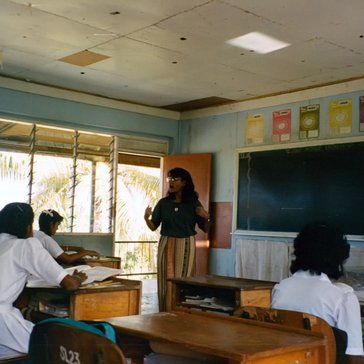
In Divya’s second year, she was thrust into resurrecting a long-abandoned girls’ netball team. Netball was a new sport for Divya, but she committed to it in the Peace Corps way. Her students taught her the rules, and she taught them the discipline of coming to practice on time, running drills, and tying academic commitments to team commitments. The school that never won anything started winning local games, then a regional championship, and then went to nationals, where they finished fourth. The girls’ pride in themselves and the team is something Divya still carries. Her Peace Corps years formed how she wanted to live and she is still dedicated to service—this time in the form of family medicine.
Michael Thomas, a small-town Oregon boy from a large family, joined the Peace Corps looking for an experience beyond the Pacific Northwest. After working in national parks during college breaks, he was ready for an extended adventure to meet new people, explore the world, and try something unique. With few expectations and a lot of openness, his life changed. He met his life partner, Divya, and was humbled by the love of his Fijian community.
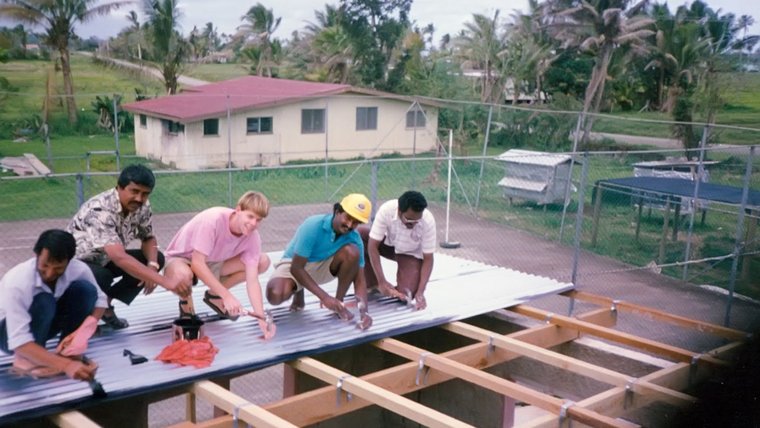
His assignment as a secondary school teacher in an urban school had different challenges to Divya’s rural experience. Academic expectations were higher, yet resources were limited and classes were large. He was only a few years ahead in his knowledge of the biology curriculum he taught, so he reviewed the subject nightly and taught it the next day.
His students had passed the 12th grade national exams and had progressed to the 13th and final grade under the Fijian system. While many of the students had no plans to progress further, one 12th grader approached him in his first year and told him her dream of becoming a physician. She asked Michael to teach her everything in science she needed to know. Motivated by her passion and committed to her success, Michael started writing his lesson plans as a study guide for her. She would take Michael’s notes and ensure she understood, even staying after school for tutoring. Michael left Fiji not knowing how this student had fared, and since the internet and social media hadn’t exploded, he often wondered about her. Six years later, though, Divya returned to Fiji to do a research project as part of her own medical training. During this time, a local medical student recognized Divya and asked about Michael. To Michael’s absolute joy, his dedicated and committed student had pursued her dreams.
And spans generations
Divya’s and Michael’s life-long partnership has gone beyond the two-year commitment of Peace Corps service. They have two daughters who grew up surrounded by an extended RPCV community. Fiji 72 reunions were a regular part of their childhood, marked by long meals, easy laughter, and stories that mixed humor with reflection. More importantly, these gatherings took the children out of their bubbles and offered a clear picture of what a Peace Corps family can look like, even decades beyond service. Their daughters are passionate, committed, and have a deep understanding of global challenges.
When their daughter, Eeshani, announced that she had applied for the Peace Corps, the moment felt surprising and inevitable. In 2024, 32 years after her parents first arrived in Fiji with packs on their backs and Tevas on their feet, Eeshani departed for Zambia to begin her own service as an Education Volunteer. She carried a phone where letter-writing paper once filled her parents’ bags. Eeshani is now serving at a primary school 40 minutes away from the nearest town, perfecting her skills at handwashing her clothes in the stream and finding the few locations where she can get cellular service.
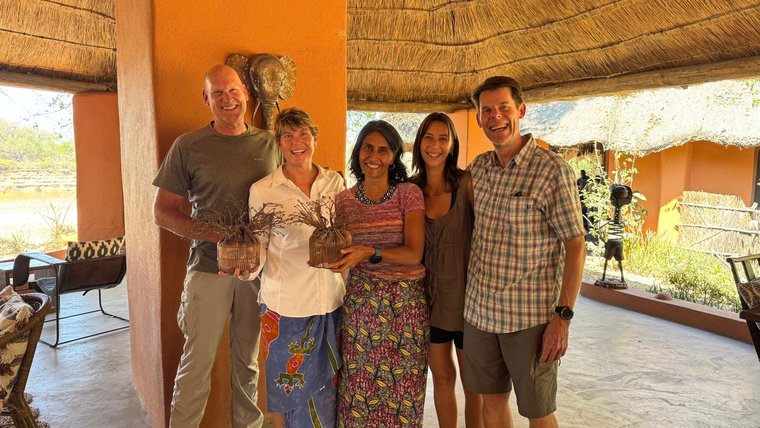
The legacy became tangible when Patti, who had watched Michael and Divya’s relationship form during the first week of service in Fiji, hosted Eeshani and her Peace Corps friends while they backpacked through Malawi. Only months later, the three members of Fiji 72, along with Loel, reunited in Zambia with Volunteer Eeshani. It was the kind of gathering that Peace Corps alone makes possible.
This group of friends and family is keenly aware of how uncommon their paths have been. Their Peace Corps story spans decades, continents, generations, and roles. It is a rare lineage and a reminder that while Peace Corps officially names three goals, alumni know that some of the most lasting outcomes of service are not written at all but rather lived.