An official website of the United States government




Enriching my nursing career as a Peace Corps Response Volunteer in Tanzania
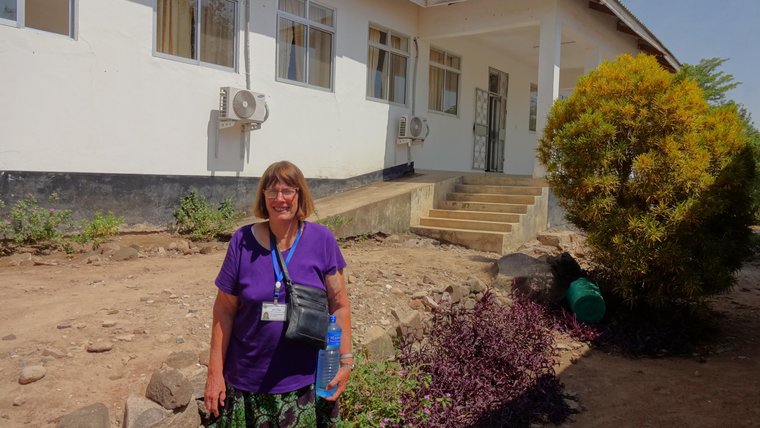
Serving as an older adult
I knew I wanted to work internationally by the time I was 20, but life and a career took priority. I unexpectedly became a single parent at a young age and raised two kids while working full-time to advance my career, including completing my master’s and doctoral degrees. In my early career I worked in hospital nursing and as a public health nurse. Then I taught nursing at a small, private Catholic college for 21 years and worked for 2 years as a maternal/child nursing consultant for the state of Illinois.
I still wanted to serve but was held back by concerns as an older adult: If something happens to me, my adult children will be left without any parents. Learning a new language will be hard at my age. I’ve barely traveled outside the U.S., and my life is secure here. I have a house, car, and other commitments.
My daughter shows me the way
My daughter served as a Peace Corps Volunteer in Ukraine from 2006-2008, and after her service she showed me a Peace Corps program for health professionals to teach in African universities. I knew I could use my experience teaching, developing new curricula, and overseeing grants in a program like that.
Once I finished my PhD and knew my children were secure in their adult lives, I was ready to look for new opportunities. I overcame many challenges in my life and felt I could adapt to something like the Peace Corps. I also wanted my children to see me take on the challenge of a lifelong goal. So I applied.
Becoming an Advancing Health Professionals Volunteer
Friends, family, and colleagues were shocked when I told them I was accepted and would be going to Africa. Honestly, I was a little nervous about the transition myself, but I moved forward with renting my house, arranging for someone to take care of my car, and working with my adult children on managing my finances.
In 2016, I arrived in Tanzania, where I served for 12 months as a Peace Corps Response Volunteer. I supported the development of a new master’s program in pediatric nursing in a university.
Teaching pediatric nursing
I taught pediatric assessment, nutrition, and malnutrition; classes were taught in English so I was able to get by with my limited Swahili. I also assisted other faculty with a community health nursing course, including helping to develop new student clinical education sites. Additionally, I wrote, carried out, and evaluated three grants—one to secure pediatric books and equipment, another to hold a nursing conference, and a third to present my own research at a conference along with my Tanzanian faculty counterpart.
A return to teaching nurse education
I was in my early 60s when I came back to the U.S. and took a job teaching nursing at the University of Illinois. This program focused on increasing access to nursing education, and many of my students were from more diverse backgrounds than I had previously taught. I enjoyed having students from so many backgrounds and was a better teacher for those students because of my Peace Corps experience.
My experience also gave me new knowledge in international health and communicable diseases. My connections to Tanzanian faculty also led to a collaborative WhatsApp project connecting Tanzanian and American nursing students.
Seven years later and now retired, I am still connected to some of my students and continue to provide feedback on Tanzanian student and faculty projects and papers. I also continue to incorporate Tanzanian values of family, peaceful relationships, and hospitality into my daily life. I am more open and accepting of others, and more knowledgeable about ways of life outside the U.S. Serving in the Peace Corps challenged me, but it was also the most rewarding experience of my personal and professional life—changing me as much as I created change.