An official website of the United States government


A Returned Volunteer's service to Ukraine goes virtual
A first lesson in culture
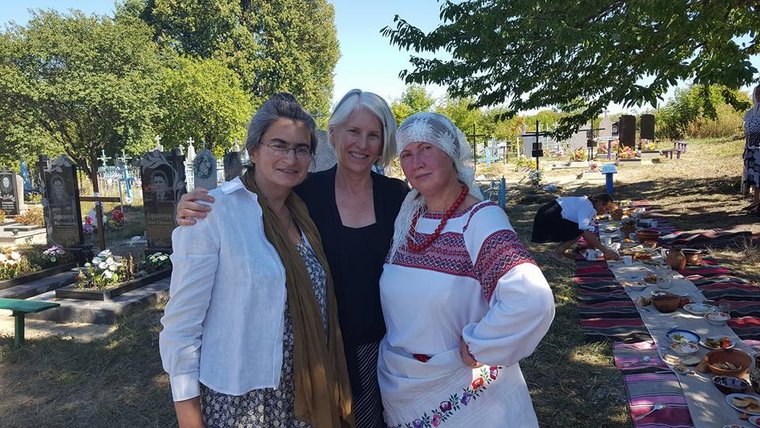
It was 10:00 in the morning and still no one was there. Andrea M. waited patiently for her counterpart to arrive, so they could discuss the project of the day. When he arrived 45 minutes later, he said simply, “Andrea, it’s a beautiful day today. We need to get our roofs patched. We’ll meet later.”
It was one of the first lessons Andrea learned about her Ukrainian colleagues during her Peace Corps service: work can be weather dependent. In winter school could be cancelled because schools lacked heat, or, during the summer, indoor work could be put on hold so community members could harvest potatoes and work in the kitchen gardens. The adaptability Andrea learned and practiced in country, during stints as a Peace Corps and then Peace Corps Response Volunteer, helped lay the foundation for her later work as a Virtual Service Pilot Participant (VSPP) working with collaborators in Ukraine. As a VSPP, having flexibility to support Ukrainian nonprofits and educational institutions is critical, as is compassion; sometimes schedules shift as Ukrainians respond to bombings and electricity outages during the ongoing war.
Beginning her journey
Andrea’s Peace Corps journey began when she was in her late 40s. At the time, she was living in Eugene, Oregon, and had an established career in finance, but a feeling of wanting to contribute to the greater global society persisted. Eventually she decided to apply to serve as a 2-year Peace Corps Volunteer supporting community and economic development.
During her service, she collaborated with Volunteers on a variety of projects, committees, and conferences. She’s used that collaborative spirit throughout her life, as a Rotary Club member in Eugene and in her role as board member for the Moscow Sister City organization in Idaho.
Finding a new path
Andrea’s commitment to Peace Corps service put her on a new path to a second career. “Probably like every Volunteer, I was asked to help with English on the side. I was shooting from the hip; I didn’t know how you teach a language in a more comprehensive way,” she said. With the support of Peace Corps staff and teaching resources from previous Volunteers, Andrea found her way.
Andrea retired from finance in her early 50s and began a new career in teaching English as a foreign language (TEFL). Andrea has taught abroad with the Department of State, worked in university classrooms, and tutored individuals both in person and online. But it was her passion for service and commitment to Ukraine that brought her back to the Peace Corps as a Virtual Service Pilot Participant in 2023.
During her first engagement, Andrea collaborated with a nonprofit that supports youth development projects across the country. Her main collaborators were Anya, a project manager, and Svitlana, an NGO leader.
Andrea saw Anya, who attended law school and participated in two exchange programs while managing the Virtual Service engagement, as one of Ukraine’s future leaders. Andrea was also inspired by Svitlana’s energy, optimism, and vision for her country's healthy future.
Although the virtual engagement has since finished, Andrea continues to offer Anya and Svitlana support as needed.
Inspiring global citizenship in Ukraine
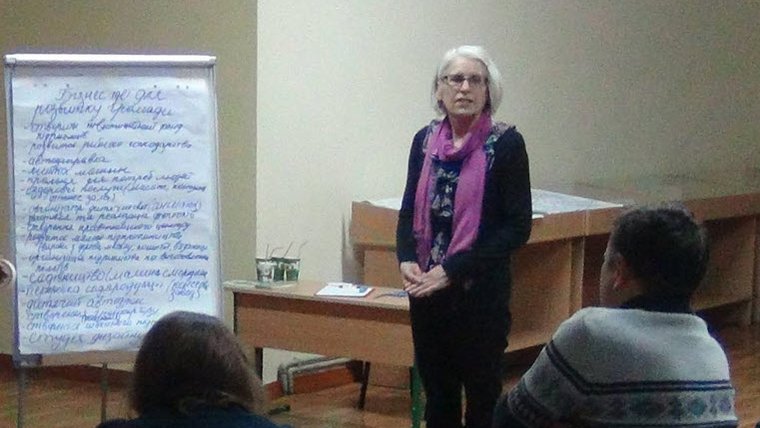
Andrea has continued her participation with virtual service; she signed up for a second youth development engagement with Ukraine to co-develop intercultural global citizenship training for youth. She’s currently working with 20 participants (university students and staff) who keep Andrea on her toes with insightful questions during each session. A memorable session was devoted to American culture, where she shared about camping and making s’mores, important traditions in her community.
Andrea’s love for Ukraine and the Peace Corps runs deep: she hosts an English language book and movie club with her Ukrainian community members and shares about Ukraine in the U.S. when given the chance. The Virtual Service Pilot gave her a new way to build her Ukraine community, and she loves encouraging others to participate. “It’s such a short-term commitment. A few months, from the comfort of your home. You meet some amazing people who really appreciate what you’re doing.”