An official website of the United States government




A Returned Volunteer receives a chief’s welcome in Cameroon
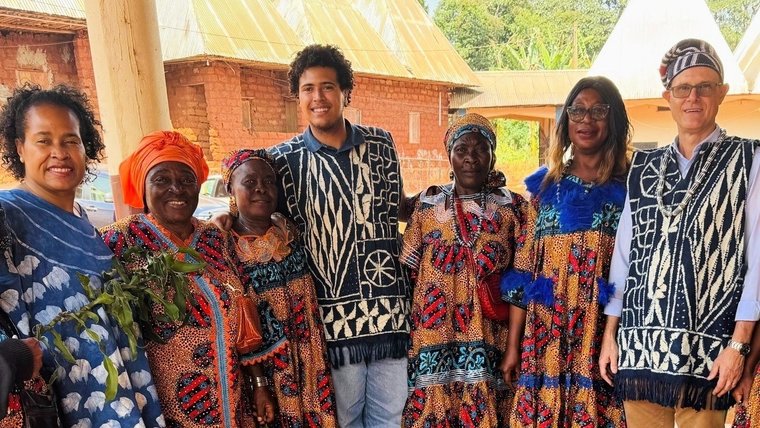
The day in December 2024 that I brought my wife of 24 years and university-aged son to meet Fo’o Sokoudjou Jean Rameau was nearly 30 years since I had first set foot in Bamendjou, a town in Cameroon’s lush and hilly West region.
One of his country’s longest serving Bamiléké chiefs, Fo’o Sokoudjou had given me the traditional name “Soh Feuguong,” which translates roughly as “providential prince,” while I was serving as a Peace Corps Volunteer in his village. From 1995-1997, I taught English at the local lycée (secondary school), where several of the chief’s children were among my students, while sponsoring after-school English and Friends of Nature Clubs.
Unbelievable warmth, hospitality, and fanfare awaited us at the chief’s compound. Upon our arrival, the chief’s wives greeted us with traditional singing, and we presented them with the traditional gifts of rice, salt, and oil that we had purchased that morning at the market. Fo’o Sokoudjou’s protocol officer and son, who had been an enthusiastic member of my English club three decades earlier, then led us on a fascinating tour of the centuries-old compound and its museum. The latter traces the rich history of the Bamendjou people and tells the story of Fo’o Sokoudjou’s long reign as chief and role in Cameroon’s fight for independence. Finally, the chief and around 30 his top notables (nobles), as well as local government leaders and lycée alumni greeted us in the chief’s court, where I presented a framed photo montage that included photos from the day he gave me my hat and traditional name. The inscription read, “In honor of the friendship between the Cameroonian and American people.” We concluded our 3-hour gathering over an extravagant lunch of pounded taro root cooked in a yellow palm oil-based sauce with herbs and spices.
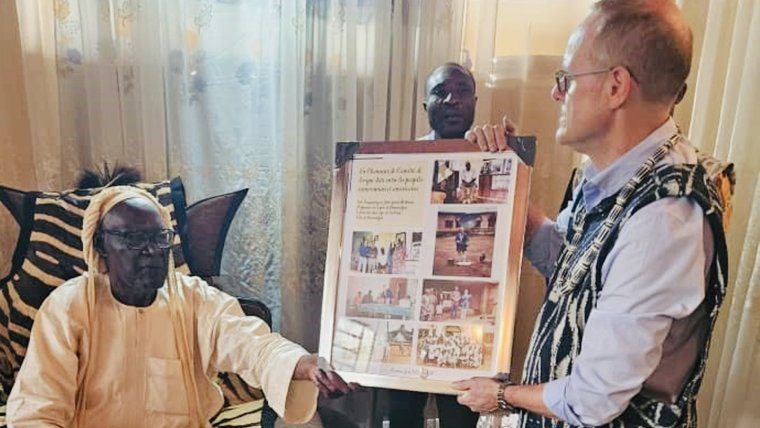
What touched me most about that day, beyond the incomparable hospitality and thoughtfulness of the chief and his family, was the symbolism of every moment and gesture. This went beyond the choreographed pomp, circumstance, and tradition that connected this visit to those of many other sons of Bamendjou who had returned home after many years. I felt a profound sense of connection to my own past—that of a 27-year-old American whose Friends of Nature Club had planted trees behind our school with the help of an Agroforestry Volunteer in the neighboring village. Like my former students who had grown to become successful professionals with their own families and displayed a proud ability to converse with me in English, the trees evoked the lasting importance of service, commitment, and the seeds that we sow, quite literally.
I thought of my native Mississippi’s renowned author William Faulkner, who said, “The past is never dead. It’s not even past.” The day I returned to Bamendjou with my family drove this idea home for me. Most of all, it opened a new chapter in my long-term friendship with a unique community and its storied leader.