An official website of the United States government


A pastime turned passion project
For as long as I can remember, I have always been passionate about art.
I grew up in a household that strongly valued creative expression, with a mom who decorated cakes for a living and painted my walls with scenes from my favorite childhood stories. As I began a career in social work, art became both a tool in my practice as well as a therapeutic pastime. However, I never could have imagined that the hobby I enjoyed my whole life would become such a vital part of my Peace Corps service.
The start of my Peace Corps journey
In May of 2023, I left home to become a Youth and Families Development Volunteer in Ecuador. After ten weeks of extensive training, I moved to my site of around 2,000 people in the Amazon rainforest. As any Peace Corps Volunteer can attest, the beginning of service is quite often overwhelming and intimidating. It takes time to earn the trust of local community members, learn how to get projects approved by the government, and build relationships. And, while adjusting to a new normal filled with initial language and cultural barriers, it's hard to know where to begin.
A project begins
Luckily, after picking me up from orientation, my counterpart happened to see a mural I designed on the wall of the Peace Corps training center. After sharing this with the local government, they expressed interest in the idea of a community art class. Just like that, my first official Peace Corps project began on my fourth day of service.
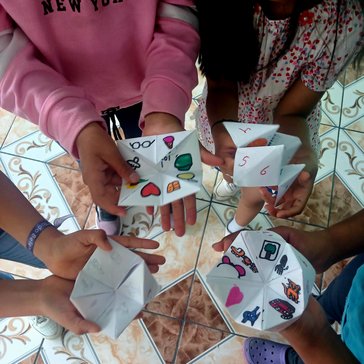
Naturally, our first class was small. We had a total of three girls in attendance, and we huddled around my desk in the Department of Social Development. With one pack of colored pencils and three pieces of printer paper between us, we started by drawing ZenTangles. As time progressed, the three girls became more comfortable, invited their friends, and then their friends invited their friends. We quickly outgrew our one-desk office space and claimed the local government’s storage closet as our new home. With larger tables, we were able to fit up to 30 kids for any given class. And to my surprise, we often did. News of the art class spread on the community’s social media, and we gained a consistent turnout each week of mainly girls between the ages of 3 and 17.
Making it work
Despite having little to no resources, we relied on “optimistic creativity” to keep the art class alive and running. We did not have many resources, nor the budget to purchase any additional art supplies. However, we all had a love for the craft and a strong motivation to make it work. More times than not, activities utilized leaves, grass, and flowers that we scavenged outside and mixed with our small supply of glue or tape. As resources became scarce, I feared that we would lose the momentum and the following that we had. To my amazement, this never happened. Consistent gatherings had bonded us as a group who were simply happy to spend time together. Each Tuesday at 2:00 pm was the time that we could spend checking in, talking about our weekends, doing a craft, and learning about each other’s cultures. And we celebrated each holiday, Ecuadorian and American, with a themed art project.
A challenge and a solution
I had learned through earlier community assessments what an important role this program was serving in the community. Few enrichment programs were available for youth outside of school hours, and there were high teen pregnancy rates, frequent drug and alcohol use, and low literacy levels.
After about 9 months of regular classes, we were told that we could no longer use our space. We needed a more permanent solution to the space issue, not to mention many more resources, to save this valuable program.
I worked with the local government to develop a grant proposal to fund and build a “youth house” that would give our class a permanent home. Our project would also provide a public library, weekly art classes, English classes, singing and dance lessons, computers, and various life and employability workshops for adults and kids alike. Our Peace Corps grant proposal for community-led projects was approved and we went on to raise $7,000.
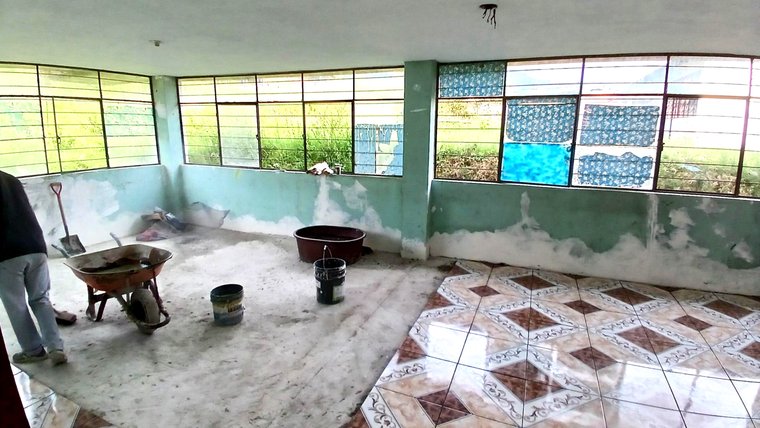
We began the lengthy renovation and construction process. The community actively participated in our project through “mingas” (community volunteer initiatives) to stock, clean, and prepare the space for its opening. Three months after receiving funding, our doors opened for business in October of 2022. To raise awareness about the new youth house, the local government promoted its programs on local social media channels, hosted marketing events, and facilitated interviews with key stakeholders.
A “forever” space for art
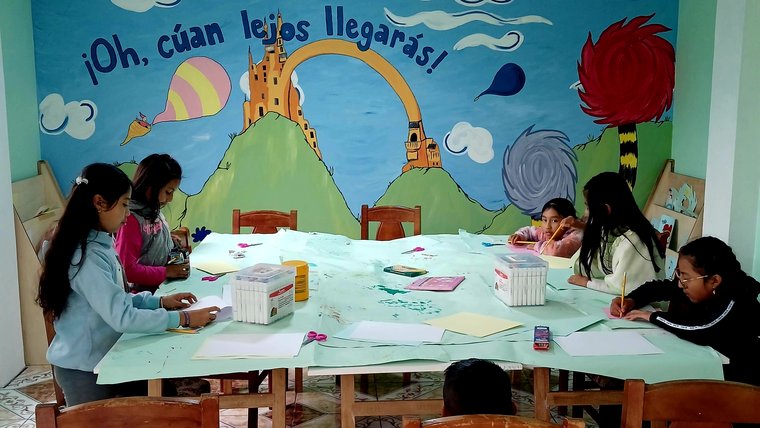
Today, the walls of our “forever” art room are painted with murals from top to bottom. Students who don’t bring their art home are encouraged to hang it on the walls to make the space feel like their own. Our shelves are stocked with new art materials. We have a printer, whiteboard, and projector to learn from other artists and to spark inspiration. We have tables to make messy and products to make the space clean again. In many ways, our weekly art class is now operating at its highest level. I am so grateful for the implementation of this grant and the many friends, family, and hometown community members who donated to our project.
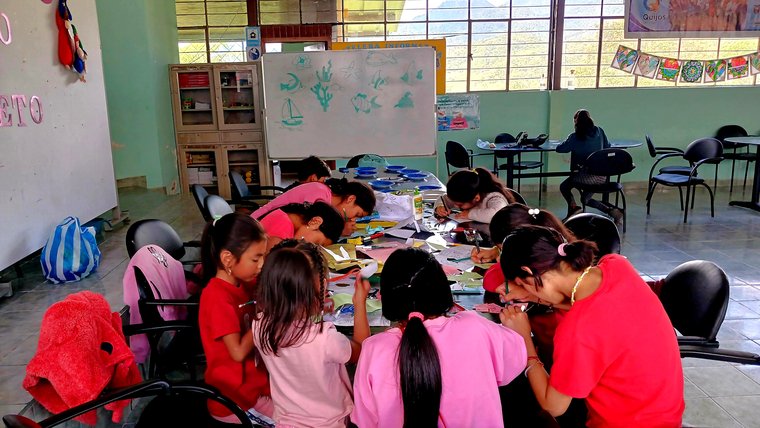
I am also proud of how our little art class has grown and evolved. The three girls who came to my first art class are still active members of our “girl crew” today. Above all else, these are the memories I hold dearest to my heart as my service ends.