An official website of the United States government




A legacy of service in The Gambia
In 1967, two very different things happened in The Gambia. At the time, each event seemed completely unrelated.
But that’s how a lot of stories begin—two seemingly separate trajectories that find a way to converge. In that convergence is the story.
The Peace Corps arrives
In 1967, the Peace Corps was only six years old, and the arrival of the first cohort of Volunteers in The Gambia that year was a single bud in the life of a growing agency. However, a lesser-known seed was also growing in The Gambia that year— a little boy, Baboucarr Bouy, who would later grow up to be an Honorable Minister in his country’s government, entered the first grade in his Gambian school.
A Gambian boy learns from Volunteers
As Honorable Minister Baboucarr grew and continued his education, his trajectory and that of the Peace Corps began to merge. There were Peace Corps Volunteer teachers in his school who deeply impacted the Honorable Minister's education and worldview. By the time he was in high school, young Honorable Minister Bouy had seen Peace Corps Volunteers in action in his community and in his school. He singles out one Volunteer, Mr. Hunt, who taught sports in the Honorable Minister's high school. “Because of my love for sports,” the Honorable Minister says, “we did a lot together.”
Seeing Peace Corps' impact
As he grew up and began the educational and career trajectory that would lead him to become the Honorable Minister of Public Service Administration and Reforms, Policy, Coordination, and Delivery of The Gambia, the Honorable Minister observed the impact of Peace Corps Volunteers on himself, as well as the educational system of The Gambia. “The communities and the government benefit a lot from the services [Peace Corps Volunteers] provide,” he says.
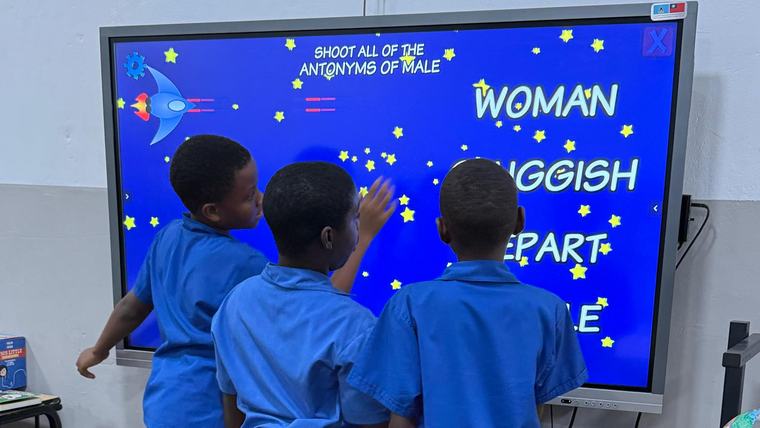
In his current position as an Honorable Minister, Mr. Bouy has observed Peace Corps Volunteers living and working in communities all over The Gambia for decades. Currently, Volunteers work on locally prioritized projects in the Agriculture, Education, and Health sectors. Volunteers are placed throughout the country, and learn to speak languages like Jola, Mandinka, Pulaar, Sarahule, and Wolof. As the Honorable Minister says, “What is most interesting about the Peace Corps’ work is where they do it—in those communities where the average Gambian would be reluctant to go. That’s where you find the Peace Corps Volunteers. Without them, most likely, those communities wouldn’t be properly served.”
An ongoing relationship
Who knows what would have happened if these two timelines had never crossed? Maybe both the Peace Corps in The Gambia and the Honorable Minister Mr. Bouy would have had the same outcome. In the end, the important thing is that the relationship between the Peace Corps and the country continues to be robust and the benefits of service in The Gambia keeps bearing fruit.

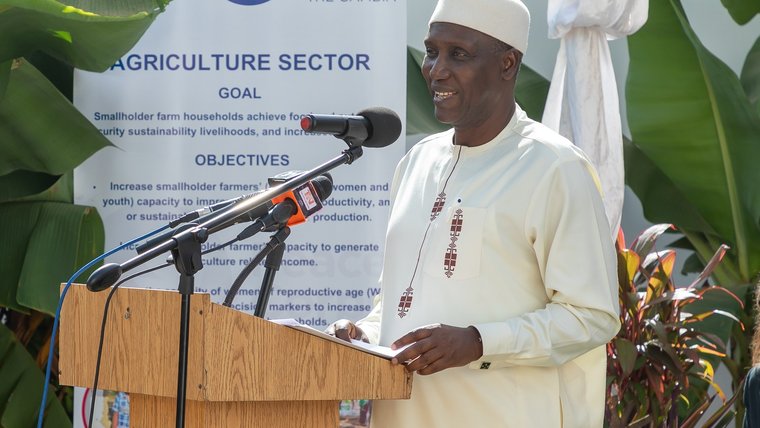
The Honorable Minister Baboucarr Bouy
The Honorable Minister Baboucarr Bouy speaks about the Peace Corps.