An official website of the United States government




From bottles to bricks: A library built with recycled bottles
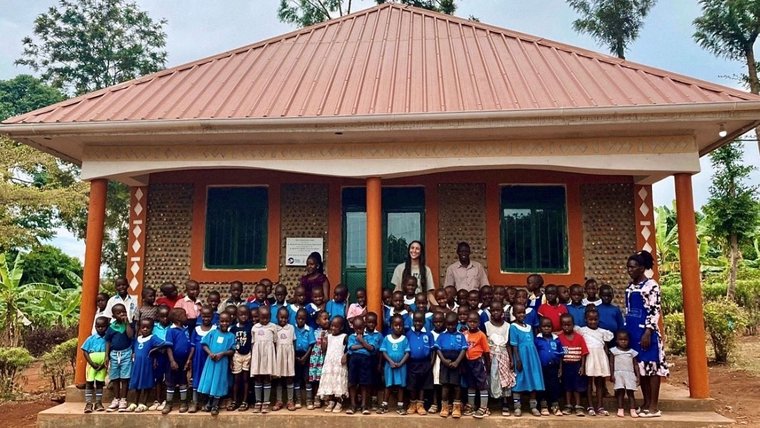
Uganda’s rural communities face significant challenges in literacy rates and reading comprehension skills.
As a Peace Corps Education Volunteer, I witnessed firsthand the challenges faced by students in rural communities due to limited access to reading materials. Determined to make a difference, I embarked on a mission to create a library at a primary school in the Central Region of Uganda. With the help of the community, local organizations, and a Peace Corps small grant, we built an eco-brick library that has become a hub for learning and community engagement. The library has not only improved students' reading skills but also fostered a culture of discipline and community involvement.
Envisioning a school library
Once we set the goal of improving students' access to reading materials, a new challenge emerged: physical space. The primary school, a small school with a large student population, didn’t have an extra classroom or storage area for books. But there was the abundance of unused land surrounding the school. There was space—just not enough classrooms. That’s when the idea of creating a library building emerged. After discussing the idea with my supervisor, we decided to pursue a Peace Corps grant to fund the construction. The next step was determining the materials for the library.
The community’s first eco-brick building
I proposed using eco-bricks, plastic bottles filled with soil that act as building blocks. Not only are eco-bricks an environmentally friendly solution to plastic waste, but they also offer an educational opportunity for students to learn about conservation. The Peace Corps grants coordinator connected me with Ichupa Upcycle Project, an organization founded by a former Peace Corps Volunteer that supports eco-brick projects in Uganda.
Building the library: A community effort
Over the course of the next year, school staff and I worked alongside the Ichupa team to build the library from the ground up. The workers oversaw the construction and educated students on plastic pollution. Meanwhile, I worked with parents and teachers to collect plastic bottles, which we used to create eco-bricks. Every week, school children and community members gathered to fill bottles with soil. The eco-bricking process became a community-wide effort, with everyone contributing in whatever way they could.
Book donations
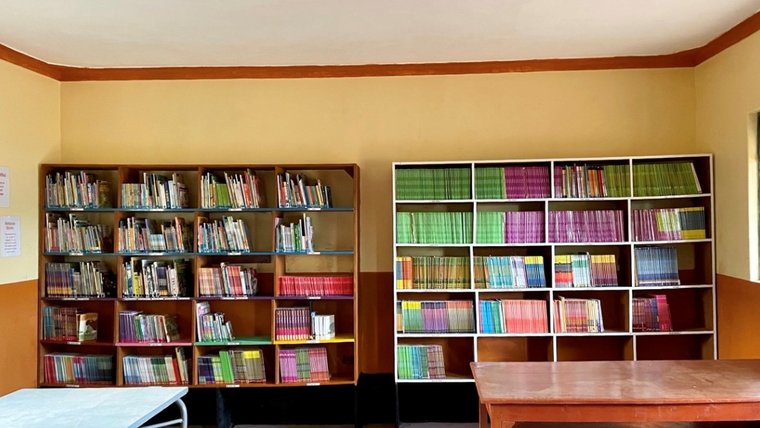
As the construction progressed, I sought out book donations from nonprofits, libraries, and friends and family. I received incredible support. Organizations abroad shipped large quantities of books to the community. My parents, who visited twice during my service, brought additional books, and on a brief trip to the U.S., I gathered more books from my hometown library to bring back to Uganda. Altogether, these donations approached nearly 3,000 reading materials, far exceeding my expectations, and remain a source of pride for me to this day.
Impact on the school
At the time of writing this article, the eco-brick library was completed just four months ago. In that short time, the library has already made a significant impact.
With books available in both English and Luganda (the local language), all the nearly 700 students can utilize the library. Teachers report that students' reading skills have noticeably improved due to the opportunity to borrow books and participate in newly organized library sessions during school hours. These sessions have become so popular, in fact, that student absenteeism has decreased on the days they occur. Additionally, student behavior has improved. Inside the library, a large poster outlines the library rules, which students take seriously, not wanting to disrupt their reading time. Teachers have observed that this good behavior has extended to the classroom.
A magnet for the community
The school library has also attracted the attention of the wider local community. Since its opening, 40 new children have enrolled at the school, likely caused by the presence of the library, as the primary school is the only one in the area with such a facility. Locals also make use of the library for private study sessions and meetings, which are held on weekends and supervised by one of the school librarians.
While the library is simply a building, its impact extends far beyond its walls, fostering a culture of reading, discipline, and community engagement that will benefit the school for years to come.