An official website of the United States government


A reading program connects generations in Saint Lucia
Tiffany H. began serving as a Literacy Resource Teacher in Saint Lucia in June 2025. In this story she describes a program that pairs children and elders in order to improve literacy and provide companionship.
Two groups face challenges
My idea emerged early during my service. Through my own observations and discussions with fellow teachers, I discovered that many children were practicing reading but not always connecting emotionally to the act of reading. Reading was an assignment, not an enjoyable activity.
At the same time, many elders in their community were isolated; they had sharp minds and full hearts but were confined within four walls due to illness, age, or disability. The turning point came during a casual conversation I had with Judy, the church secretary, who shared, “Some of our elderly are very depressed and lonely and are unable to get out and visit with other neighbors. Nobody comes to visit them except me, to give them Holy Communion.”
Those conversations stayed with me.
Alongside my fellow teachers, we also recognized that children often flourish when they have an audience that truly listens. Children love to feel helpful. When they read to someone who appreciates it, their motivation grows naturally.
Together, we saw an opportunity to connect two groups with complementary needs: children who needed meaningful literacy experiences and elderly community members who longed for companionship and connection. From that shared vision, Generation Connect Literacy was born.
Books as a bridge
The idea began quietly, like a whisper: What if a simple book could become the bridge between children and elders? That relationship could bring more enjoyment to children and to elders who longed for company.
Within a week, the program blossomed into something far greater than a simple literacy initiative. What began as conversations about reading practice and loneliness quickly evolved into a deeply meaningful project rooted in compassion, empathy, and human connection.
The program’s purpose was straightforward yet profound: support early reading skills through authentic, meaningful practice; build empathy, respect, and social awareness in young children; offer emotional nourishment and companionship to shut-in elderly residents; and strengthen community ties by linking generations. No expensive equipment. No complicated curriculum. Just stories told by children who needed to read them, to elders who needed to hear them.
A hopeful beginning
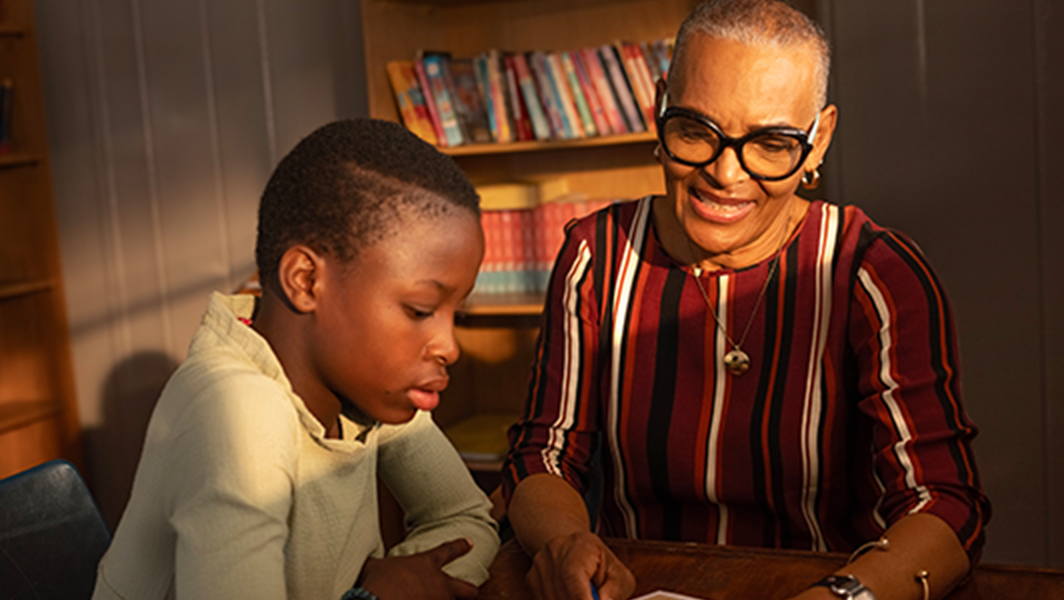
The first group of children to participate were abuzz with excitement. In their little hands they held storybooks; some with bright illustrations, some with repetitive patterns perfect for building reading fluency. I gently reminded them, “Read slowly. Be polite. Smile. Remember, this is special. Afterwards we will say a prayer and give a hug." But perhaps the most important reminder was this: “You are going to make someone’s day better.”
That afternoon in November, the group walked the familiar roads of their community. The children held their books like precious treasures. You could feel them carrying the kind of excitement children carry on Christmas morning. Their voices bubbled with anticipation and their steps quickened with eagerness and every few minutes, one child would ask to sing one of their favorite school songs. You could feel their happiness surrounding them like sunlight.
Punchita welcomes young readers
The first elderly participant was Punchita A., a woman who had lived most of her life in England and then returned to her community where she was born and raised. Now homebound window.
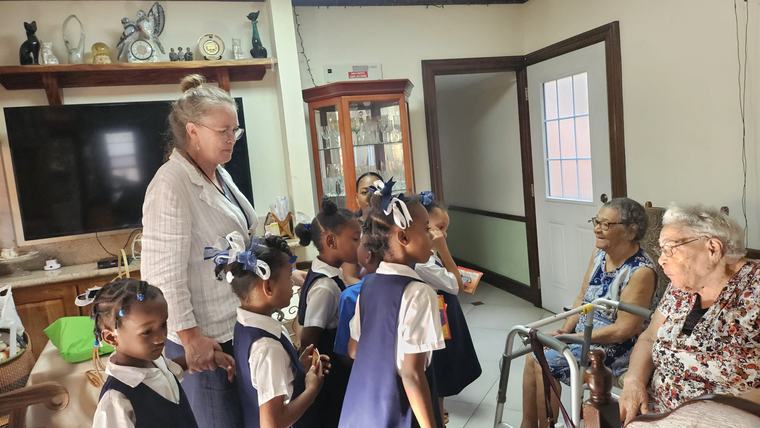
When the students walked in, she gasped softly and pressed her hand to her chest. “Welcome!” she cried, her voice trembling with surprise and joy. “Look how you all shine!”
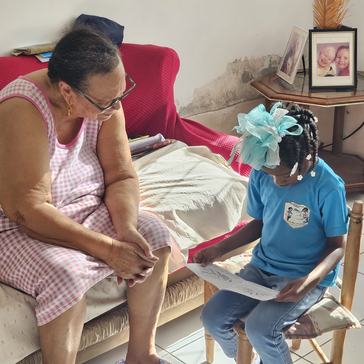
The children settled in her living room. One boy read with confidence. Another stumbled on the words, looked up nervously, and found Ms. A. smiling at her gently. “Take your time, sweetheart,” she whispered. “I am listening and you are doing so well.”
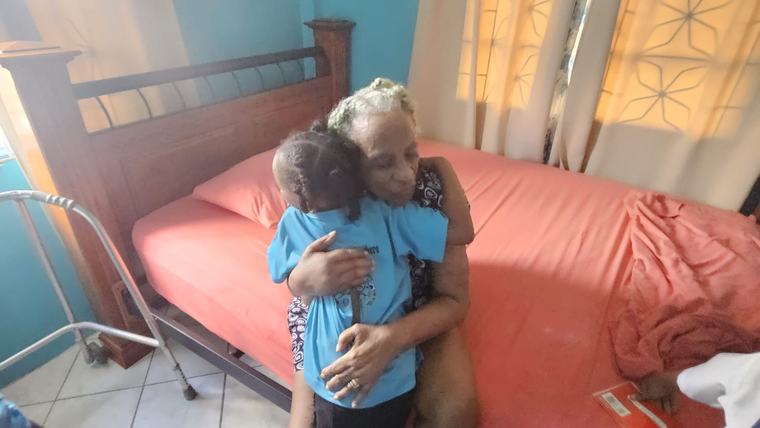
Those simple words changed the student. Her shoulders relaxed, her voice steadied. When she finished, Ms. A. clapped her hands lightly and told her, “You did beautifully.” After every story, Ms. A. gave thanks, and at the end, insisted they take cookies and juice. After refreshments, they asked Ms. A., "Will you pray with us?" "Of course, I will," she said delightedly.
Before heading to the door, all the children practically piled on Ms. A. screaming, "We love you, Ms. A.!" The children left, glowing.and depressed, she rarely saw children except through her
Literacy wrapped in love
And that was only the beginning.
On two Fridays each month, five selected students walked out of school with me (their Peace Corps Volunteer) and their teacher (Ms. Mhakeida one week, Ms. Merkel another week) to visit an elderly member of the community. What happened during those visits was far more powerful than anyone had expected. It was not just reading. It was connection, love, generosity, tenderness, and healing.
Ms. Merkel said, “I saw my students in a different light; they were helpers, listeners, comforters.” Ms. Mhakeida shared: “Some of the children who were shy in class completely flourished during the visits. The elderly made them feel important, and that confidence carried back into the classroom.” The school principal Ms. Cyria said, “This is what education is meant to look like: community, kindness, and purpose.”
It was a literacy activity, yes, but literacy wrapped in humanity.