An official website of the United States government




A granddaughter follows in her grandfather’s footsteps of service
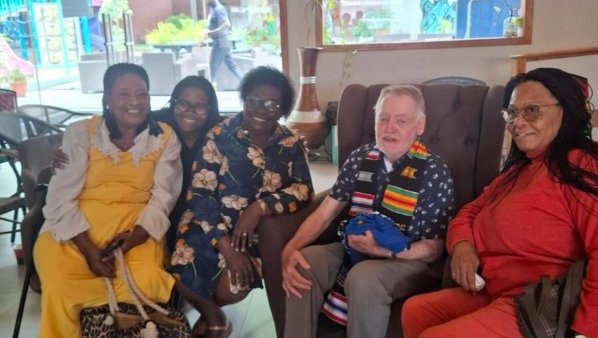
Asha’s grandfather Steve served in the Peace Corps from 1962 to 1964. Without knowing all the details, Asha recognized how service instilled values in him that she admired.
After finishing college, Asha applied to the Peace Corps and was invited to serve as an Agriculture Volunteer in Ghana—the same country, where, more than 60 years earlier her grandpa served as a teacher. Ghana was the first country to welcome Peace Corps Volunteers in 1961, making 2026 the 65th anniversary for the agency and a year of celebration for Peace Corps/Ghana as it commemorates 65 years of collaboration and hosting Volunteers like Steve and Asha.
Steve recently made a trip to visit Asha, completing a cycle he’d started so long ago. In addition to visiting his granddaughter’s site and reconnecting with people he’d worked alongside so long ago, the pair sat down at the Peace Corps office in Accra to share stories and the impact of their service, then and now.
Craving something big
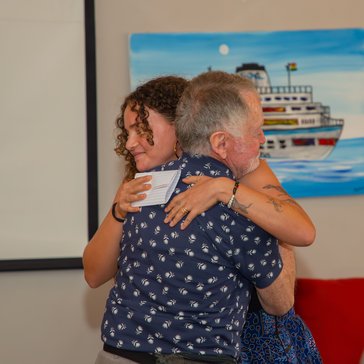
Looking at her grandfather, Asha says, “I always saw it as a big thing that you did that just changed your life. I didn't know the details of it, but I knew you grew up in a small town in Michigan, and then you served in Ghana when you were my age, and it just changed the course of your life.” That knowledge became the impetus for her own Peace Corps application. Asha was “craving something big” when she finished university. Something that would open her mind to new possibilities, and Peace Corps seemed like the perfect fit.
Steve nods in agreement. “It really was like that for me. You didn't know what exactly you wanted to do, but you wanted to have a big experience … to see more of reality. And that's exactly what I felt at the time before I joined the Peace Corps. I’d say to anyone able to go on to university that there's so much about reality that is beyond what you learn in an academic institution. It’s important to really try to be shaken by some of the unpleasant realities of the world. And no matter where you go in the Peace Corps, just going to a different country where it's likely that you'll have some ‘fruitful, cultural shock’ is a big experience.”
Starting something special in Ghana
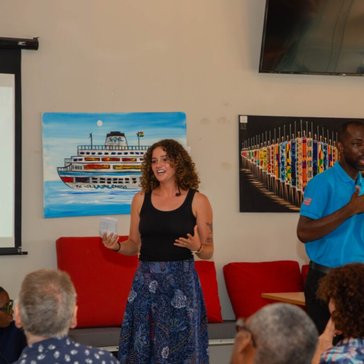
Asha always knew joining the Peace Corps would greatly impact her life. She says, “I'm only five months into being in my community, but already I feel like there's so many things I've learned that I just hope I will continue to take on into the rest of my life. Like, Ghanaian friendliness and professionalism; how to work with the community; how to collaborate on coming up with a project idea with so many people; and how to take initiative on project ideas and get comfortable talking to so many different people from so many different places. All of these—and so many more—are skills I'm learning through my service, that I want to carry through the rest of my life.”
She also points out, “I think a lot of Volunteers sometimes fear that it goes away after you serve. It feels so real in the moment, but then you go back to the U.S. and maybe you lose some of those things you learned. I'm interested in how you feel now, over 60 years after your service, what things stuck with you or how your service impacted your life?”
A moral obligation
Steve considers for a moment and says, “As I was contemplating moral dilemmas during my service and trying to think them through … that led me to be determined, and I’ve kept that. I enjoyed teaching in the Peace Corps, so, I wanted to continue to teach, but I thought I'd like to teach at the university level in an area that dealt with these moral issues and problems I was fascinated by. In the end, I got into the London School of Economics, and I got my PhD in political philosophy, which was about trying to work out what the ideal state in society would be. I was determined to try to find out. I knew there was, and still is, a problem with world poverty, so it was the moral obligation that was driven home to me by my experience in Ghana. My Peace Corps experience pretty much impacted my life ever since. Lots of my desire to be engaged came from Peace Corps service.”
Ongoing commitment to Peace Corps' three goals
He continues, saying, “a big part of being a Peace Corps Volunteer is continuing the cultural exchange between your country of service and the U.S. I realized that's an ongoing responsibility, even after you COS [complete service], you continue to have this responsibility to be the bridge between where you served and your home country.”
Asha echoes his thought; “I've been very close to you my whole life. I see you being that person who fulfills those three goals every single day. You choose to do the right thing every single day, and to be a good person and to promote friendship and to believe in the good in people. You're an example [showing] that it does keep living on even after you finish your service.”